

Canadian Cell Phone Setup Fees: Banned Since June 2026
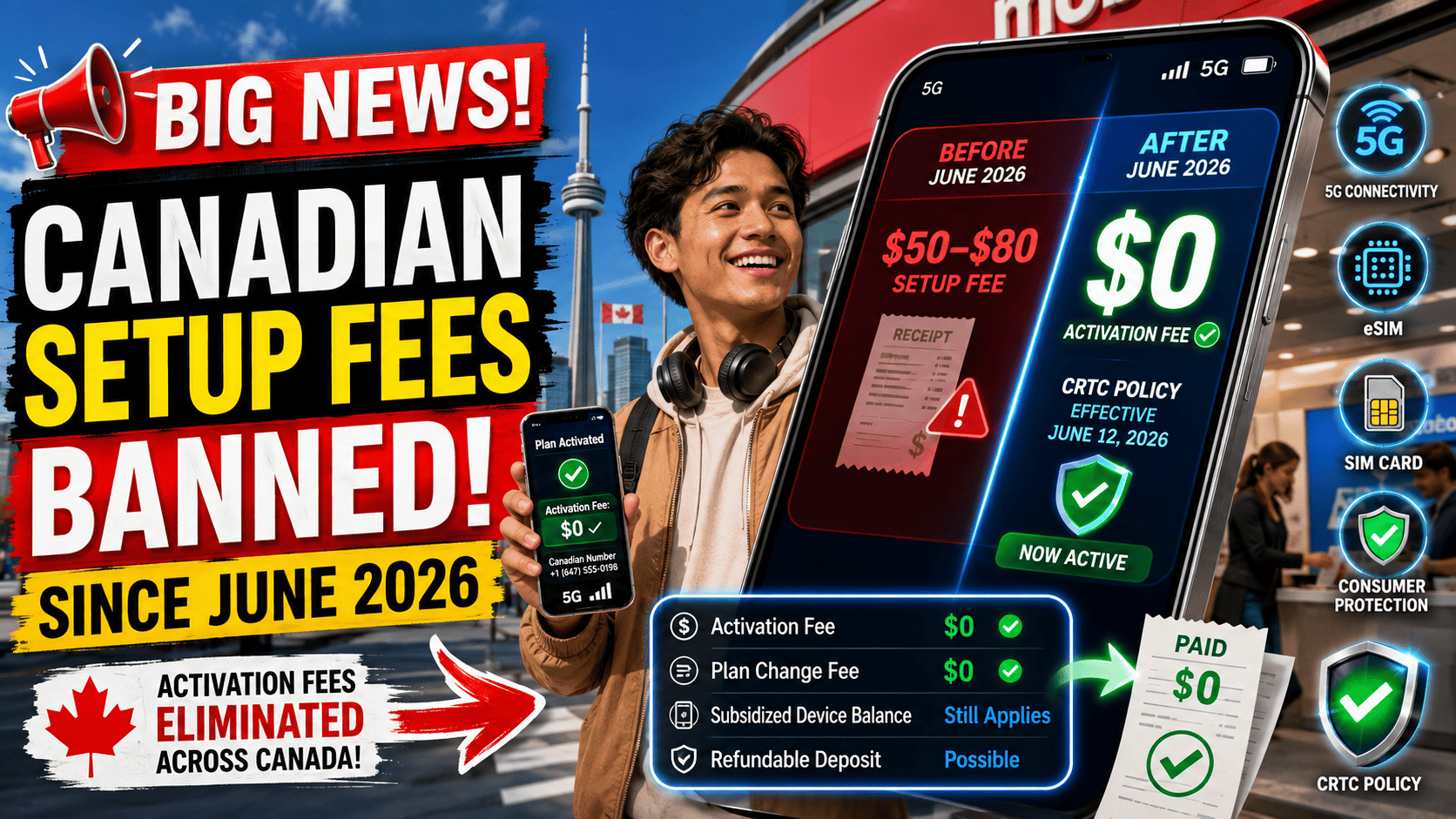
Canadian carriers can no longer charge you a setup or activation fee. CRTC Telecom Regulatory Policy 2026-43 took effect on 12 June 2026 and bans any fee for activating a new plan or changing an existing one. If you were quoted $50 or $80 to get connected, that charge is no longer permitted.
This article previously explained how to avoid those fees. The rules changed, so here is what actually applies now. If you are comparing the total cost of getting connected, our guide to why Canadian phone plans are so expensive explains the other costs that can still affect your monthly bill.
What the CRTC banned
The policy prohibits "any fee incurred as a result of activating a new retail telecommunications service plan or modifying an existing one." In plain terms, three charges are gone:
- Activation fees — what carriers charged to start service on a new line.
- Plan change and upgrade fees — what they charged to move you between plans.
- Early cancellation fees, but only where no subsidized device is involved.
The protections cover individual and small-business mobile customers, and individual home internet customers of providers subject to the Internet Code.
One timing detail worth knowing: the underlying legislative amendments took effect on 30 October 2025, but the CRTC said it would "only enforce the amendments to the Codes starting on 12 June 2026" to give providers time to implement them. So mid-2026 is the date that matters in practice.
If the fee change has you reconsidering what type of service to start with, this comparison of the best prepaid SIM cards in Canada is a useful next step.
What you can still be charged
The ban is narrower than "carriers can never charge you anything extra." Four things survive it.
A device balance. If you took a phone on a subsidized plan and leave early, you still owe the remaining device cost. That is not an activation fee, and the CRTC left it intact — early cancellation fees "remain permissible when tied to device subsidies."
Physical installation. Reasonable fees for installation work at your premises are still allowed. This matters for home internet, not mobile.
Optional extras you chose. Fees for optional products or services you explicitly opted into are still permitted. Read what is ticked at checkout.
A security deposit. This is one cost newcomers may encounter when applying for some postpaid services. A refundable deposit is different from an activation fee, so it falls outside the CRTC ban. The amount, eligibility rules, and refund timing vary by provider. If you have little or no Canadian credit history, see the different ways to get a Canada phone plan without a credit check.
| Charge | Still allowed? |
|---|---|
| Activation / setup fee | No |
| Plan change or upgrade fee | No |
| Early cancellation, no device subsidy | No |
| Remaining balance on a subsidized phone | Yes |
| Home internet installation | Yes, if reasonable |
| Optional add-ons you selected | Yes |
| Refundable credit deposit | Yes — not a fee |
| Taxes | Yes |
For newcomers who are still learning how Canadian credit works, it may also help to understand how to build credit in Canada before choosing between prepaid and postpaid solely because of a credit check.
What this changes for newcomers
The practical effect is that switching got cheaper, and that changes how you can think about your first months in Canada.
Before the ban, moving from a prepaid line to a postpaid plan could come with an activation fee on the new line. That friction could make people feel they had to get the decision right immediately.
Now you have more flexibility to start with one type of service, learn how much data you actually use and how the network performs where you live, and compare again later.
That can make prepaid especially useful as a starting point for some people. For example, international students can compare the trade-offs in our guide to mobile plans in Canada for international students.
It also means you should be sceptical of any provider still advertising a saving specifically against a standard activation or setup fee. Judge a plan instead on the monthly price, data allowance, coverage, calling and texting, device requirements, and other terms that actually affect you.
If you are preparing before travelling, you can also explore Canadian SIM and eSIM options before arrival rather than making the whole decision after landing.
Watch for stale quotes and slow compliance
Two things to keep an eye on.
Plenty of comparison sites, forum posts, and older provider pages may still list activation fees because they were written before June 2026. If a page quotes you a setup fee, check when the information was published or last updated.
The CRTC also opened a compliance proceeding after the rules took effect concerning fees introduced by Bell, Rogers, and Telus. So if a Canadian provider tries to charge you something that appears to be an activation or plan-change fee, ask exactly what the charge is for before paying.
If the provider insists on a prohibited fee, you can escalate the issue to the Commission for Complaints for Telecom-television Services.
Where this leaves ordering before you fly
Ordering a Canadian plan before you arrive was never only about avoiding an activation fee.
The more useful question now is whether arranging your service earlier gives you a plan, price, and setup that better fit your trip.
If being prepared before arrival matters to you, read how to get a Canadian phone number before you land. A Canadian number can be useful for callbacks and account setup, but it is not universally required for banking or other Canadian services.
If banking is specifically why you are considering a local number, our guide explains whether you need a Canadian phone number to open a bank account.
You should also decide whether you want a digital or plastic SIM before ordering. Here is a simple comparison of eSIM vs physical SIM for newcomers to Canada.
GetCanadaSIM plans have no setup fee [VERIFY current plan terms], but standard activation fees are no longer the reason to choose one provider over another. Compare the monthly price, plan inclusions, credit requirements, activation process, and whether the option fits your arrival timeline.
Compare current Canada SIM plans when you are ready to look at the available options.
FAQ
Do Canadian carriers still charge activation fees?
No. CRTC Telecom Regulatory Policy 2026-43 took effect on 12 June 2026 and bans fees for activating a new plan or modifying an existing one. If a provider still tries to charge one, question it at the point of sale — some checkouts were slow to update after the ban.
How much was a Canadian cell phone setup fee?
Historically it ran to around $50–$80 per line, depending on the carrier and whether you signed up in store or online. Those amounts are now historical only. No Canadian provider is permitted to charge an activation or plan-change fee on a new or modified plan.
Can I still be charged for cancelling my Canadian phone plan early?
Only if your plan included a subsidized device, in which case you owe the remaining device balance. Where no device subsidy is involved, early cancellation fees are banned outright. That makes switching providers free for anyone on a bring-your-own-phone plan.
Is a security deposit the same as a setup fee?
No, and it is still allowed. A deposit of roughly $150–$300 is refundable, usually after about twelve months of on-time payments, so it is not a fee. It is the standard substitute for a credit check when you have no Canadian credit history.
Follow Get Canada Sim on Google
Make Get Canada Sim a preferred source to find our latest Canada SIM and eSIM guides in Google Search.