

eSIM Compatible Devices: Supported Phones List 2026
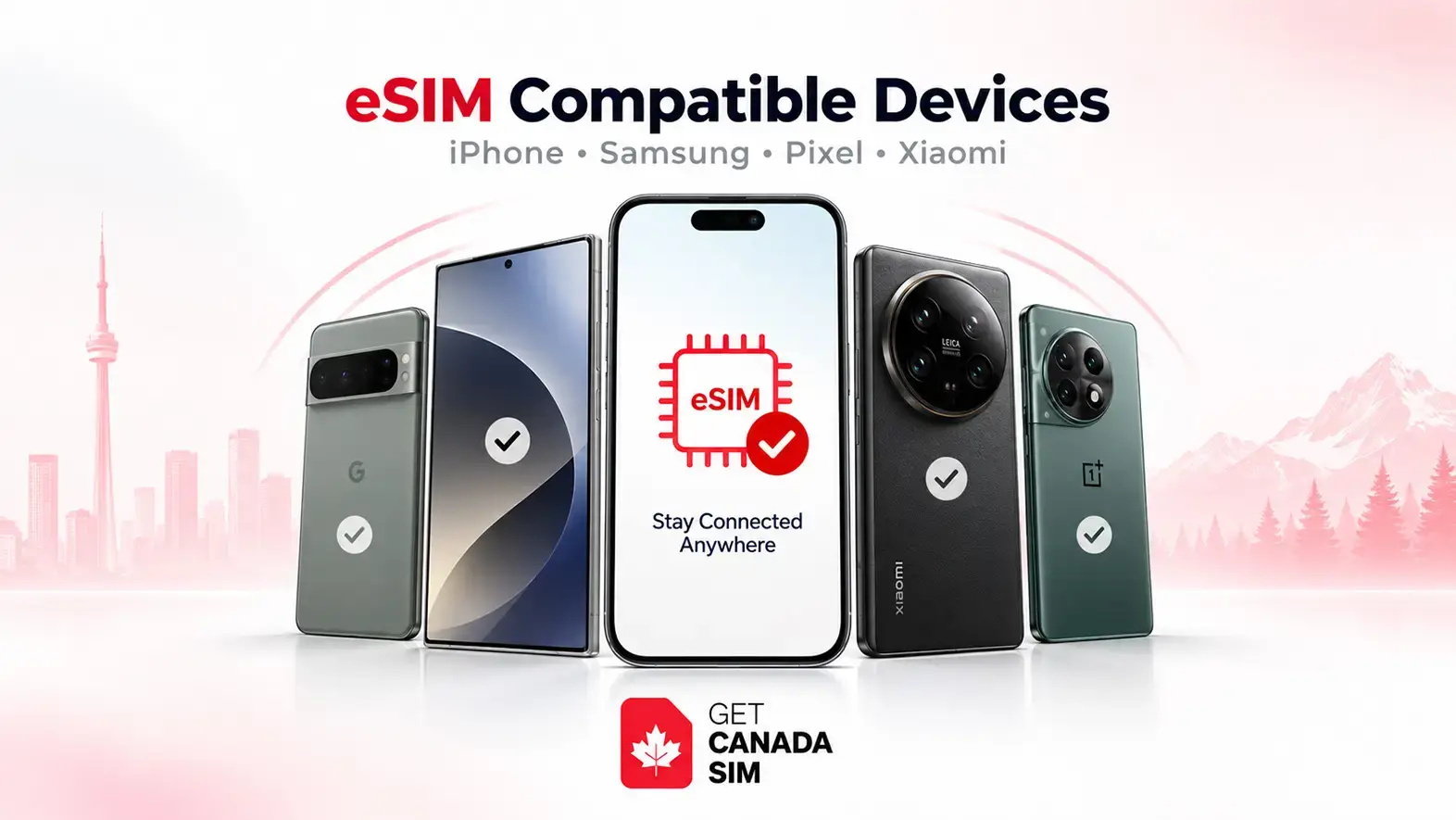
Most recent iPhones, Google Pixel phones, many Samsung Galaxy models, and a growing number of Android phones support eSIM. But eSIM compatibility is not determined by the phone name alone. The exact model number, country where the phone was sold, carrier lock, software and mobile provider can all matter.
For a quick reference, Apple generally supports eSIM from the iPhone XS, XS Max and XR onward; Google says every Pixel 4 and later supports eSIM; and Samsung currently supports many Galaxy S, Z, Note, A and XCover models. Xiaomi, Realme, OnePlus, Motorola and other Android manufacturers have more model- and region-specific support.
If you only want to check the phone already in your hand, use GetCanadaSIM's guide to checking whether your phone supports eSIM. If you are new to digital SIMs, start with what an eSIM is and how it works.
Is my phone eSIM compatible?
The fastest way to answer “Is my phone eSIM compatible?” is to check the phone itself rather than relying only on an online eSIM supported phones list.
- Open your mobile or SIM settings and look for Add eSIM, Set Up eSIM, Add Cellular Plan, or Download SIM.
- Dial *#06# and look for an EID. An EID is an identifier associated with the phone's embedded SIM system.
- Find your exact model number, not just a name such as “Galaxy S24” or “iPhone 15.”
- Check the manufacturer's specifications for that exact model and country.
- If you want to use a different carrier, also make sure the phone is unlocked and that the carrier supports eSIM on that device.
An Add eSIM option or an EID is a strong sign that the phone has eSIM hardware, but it does not guarantee that every eSIM provider will work with it. Google, Samsung and Xiaomi all note that carrier or regional support may still apply.
If your real question is whether the device will work after you arrive in Canada, eSIM support is only one part of the check. You should also confirm the phone's network compatibility and lock status using GetCanadaSIM's phone compatibility and IMEI guide for Canada.
What phones are compatible with eSIM?
Here is the useful short version of the eSIM supported phone list.
| Brand | eSIM compatibility |
|---|---|
| Apple | iPhone XS, XS Max, XR and later, subject to regional exceptions |
| Google Pixel | All Pixel 4 and later models; some Pixel 2, 3 and 3a versions also support eSIM |
| Samsung Galaxy | Many Galaxy S20–S26, Z Fold/Flip, Note20, selected A-series and XCover devices |
| Xiaomi | Selected models including Xiaomi 14T, 14T Pro, 15, 15 Ultra and 15T |
| Realme | Selected regional models only; support is not standard across the lineup |
| OnePlus | Selected models including OnePlus 13 and OnePlus Open |
| Motorola | Selected Razr, Edge and other models; model/carrier support varies |
| HMD / Nokia | Selected devices including HMD Skyline, Nokia X30 5G and Nokia G60 5G |
This table is better treated as a starting point than a promise. A complete list of mobile devices compatible with eSIM worldwide cannot stay perfectly universal, because manufacturers sometimes sell different hardware or enable different SIM configurations in different markets.
Samsung is a good example. Its official compatibility lists vary between countries, and Samsung explicitly warns that a device shown as eSIM-compatible in one market may not support eSIM in another.
iPhone eSIM compatible devices
Apple has one of the simplest compatibility rules.
Apple says you generally need an iPhone XS, iPhone XS Max, iPhone XR or later to set up an eSIM. Regional exceptions still apply, especially for devices originally sold in mainland China, Hong Kong and Macao.
| iPhone generation | eSIM support |
|---|---|
| iPhone XS / XS Max | Yes, subject to region and carrier |
| iPhone XR | Yes, subject to region and carrier |
| iPhone 11 family | Yes |
| iPhone SE, 2nd generation | Yes |
| iPhone 12 family | Yes |
| iPhone 13 family | Yes |
| iPhone SE, 3rd generation | Yes |
| iPhone 14 family | Yes |
| iPhone 15 family | Yes |
| iPhone 16 family / 16e | Yes |
| iPhone 17 family / iPhone Air / supported later models | Yes, regional SIM configuration varies |
| iPhone X and earlier | No native eSIM support |
If you specifically own an iPhone 12, GetCanadaSIM has a separate iPhone 12 eSIM compatibility and Dual SIM guide.
How to activate eSIM in iPhone
Once you know the iPhone is compatible, activation normally begins at:
Settings → Cellular or Mobile Data → Add eSIM
From there, the available method can include a QR code, carrier activation, manual details or transfer from another iPhone.
Because activation is a different problem from device compatibility, see the full GetCanadaSIM guide on how to activate eSIM in iPhone for setup, transfer and troubleshooting instructions.
This separation is important: an eSIM-compatible iPhone can still fail to activate an eSIM if the phone is locked, the carrier does not support the device, the activation details are wrong, or the specific regional model has restrictions.
Samsung eSIM compatible devices
The Samsung eSIM compatible list is broader but more complicated because Samsung sells many regional variants.
Samsung Australia's August 2026 compatibility guide currently identifies these major phone families as eSIM-supported for applicable Australian variants. Samsung's Canada, UK, US and other regional support pages can differ.
| Samsung family | eSIM-compatible models/families |
|---|---|
| Galaxy S | S20, S20+, S20 Ultra through the S26, S26+ and S26 Ultra families |
| Galaxy Z Fold | Fold2, Fold3, Fold4, Fold5, Fold6, Fold7, Fold8 and selected variants |
| Galaxy Z Flip | Z Flip, Flip 5G, Flip3, Flip4, Flip5, Flip6, Flip7, Flip8 and selected variants |
| Galaxy Note | Note20 and Note20 Ultra on supported variants |
| Galaxy A | Selected models such as A35, A36, A54, A55 and A56 depending on market |
| Galaxy XCover | Selected XCover7-series devices |
The Galaxy Note20 is a good example of why exact-device verification matters. Samsung Bangladesh's specifications for one Note20 version show Single SIM + Embedded SIM, while Samsung also notes that eSIM availability can depend on country or carrier.
To check a Samsung yourself, open:
Settings → Connections → SIM Manager
If Add eSIM appears, the phone likely has eSIM functionality. You should still confirm the exact model before purchasing service.
Android phone support eSIM list
There is no universal Android phone support eSIM list because Android is an operating system used by many different manufacturers.
Two phones running the same Android version can have completely different SIM hardware.
The most reliable way to think about Android eSIM support is by manufacturer:
| Manufacturer | General situation |
|---|---|
| Google Pixel | Broad eSIM support |
| Samsung | Broad support on premium and selected mid-range models |
| Xiaomi | Growing but model- and region-specific |
| Realme | Limited and highly regional |
| OnePlus | Selected premium models |
| Motorola | Selected Razr, Edge and other devices |
| HMD / Nokia | Selected models |
| OPPO / HONOR / Huawei and others | Depends heavily on exact model and region |
So if you search for an eSIM supported phone list or list of eSIM compatible devices, always confirm the manufacturer's specification after finding your model in a third-party list.
Google Pixel eSIM supported phones list
Google provides one of the clearest manufacturer answers.
Google currently states:
| Google Pixel | eSIM situation |
|---|---|
| Pixel 4 and later | All models support eSIM |
| Pixel 3a | Supported, with some purchase-region/carrier exceptions |
| Pixel 3 | Support depends on where and from whom it was purchased |
| Pixel 2 | Only certain Google Fi versions |
| Original Pixel | No eSIM |
For frequent travellers, newer Pixels provide another useful feature. Google says Pixel 7 and later can use two eSIM profiles at the same time when the carrier supports it. U.S. versions of some Pixel 10-series devices are eSIM-only, while models sold elsewhere can use different SIM configurations.
This is another reason that “Pixel 10 supports eSIM” and “this exact Pixel 10 has a physical SIM slot” are two different questions.
Xiaomi eSIM phone list
Xiaomi's eSIM phone list is smaller than Apple's or Google's and should be checked model by model.
Xiaomi currently documents eSIM functionality on models including the Xiaomi 15, Xiaomi 15 Ultra, Xiaomi 14T and Xiaomi 14T Pro, and its Bangladesh support documentation confirms eSIM support on the Xiaomi 15T. Xiaomi also says eSIM availability may vary by country, region and carrier.
The Xiaomi 15, for example, supports eSIM and provides eSIM-management options under its mobile-network settings.
Do not assume that another Xiaomi phone supports eSIM simply because these models do. Check the specifications for the exact device.
Realme eSIM phone list
Realme is a particularly good example of why a brand name is not enough.
There is no simple rule that “new Realme phones support eSIM.” Realme's current specifications show different support by model and region.
For example, the Realme 16 Pro+ 5G officially lists eSIM support for its EU version while stating that other regional versions are unsupported. Meanwhile, current Realme devices such as the Realme 16x 5G and some other models explicitly list eSIM as unsupported.
So when searching for a Realme eSIM phone list, use the model's regional specification page rather than assuming the entire series behaves the same way.
Other eSIM-enabled devices worth checking
Several other manufacturers now sell eSIM enabled devices, but compatibility should still be checked individually.
OnePlus officially lists eSIM functionality on models such as the OnePlus 13 and OnePlus Open, with carrier compatibility conditions. HMD documents eSIM use on the HMD Skyline, while Nokia's official specifications show eSIM on the Nokia X30 5G and Nokia G60 5G. Motorola's support documentation also confirms eSIM capability on selected Razr models, subject to carrier support.
The practical rule remains the same:
Brand → exact model → model number → region → carrier.
That sequence is much safer than trusting a generic compatibility list.
Are some eSIM-compatible devices better for frequent travellers?
Yes, but there is no single phone that is automatically ideal for every traveller.
For frequent international travel, the most useful features are Dual SIM, support for two active eSIMs, the ability to store several eSIM profiles, broad cellular-band support, and an unlocked device.
Recent iPhones and Pixels are especially flexible in this area. Apple supports two active eSIMs beginning with the iPhone 13 generation on supported models, while compatible iPhones can store multiple eSIM profiles. Google says Pixel 7 and later can use two eSIMs simultaneously when supported by the carrier.
A recent Samsung Galaxy with both physical SIM and eSIM can also be useful if you travel through places where local eSIM availability is limited.
This is where personal preference matters. Some travellers prefer an eSIM-only setup because they can load a plan before departure. Others deliberately choose a phone that retains a physical SIM slot as a backup.
That split also appears in real-world discussions. Some frequent travellers on Reddit describe switching between travel eSIMs across several countries with little trouble, while others prefer retaining physical-SIM support because not every local carrier offers eSIM. These reports are anecdotal, but they highlight a real decision: convenience versus maximum fallback flexibility.
If you are deciding between the two formats, see GetCanadaSIM's eSIM vs physical SIM comparison.
Does an eSIM-compatible phone work with every eSIM?
No.
This is probably the most important distinction in this guide.
Device eSIM compatibility means the hardware can use an eSIM.
Carrier compatibility means a particular mobile provider is willing and technically able to provision service on that device.
Network compatibility means the phone supports the network technologies and frequency bands needed where you will use it.
All three need to line up.
For example, Samsung warns that eSIM service can vary by country and carrier, while Google similarly says eSIM use depends on both the phone and mobile carrier.
If you are specifically preparing for Canada, confirm the device first and then review the current Canada eSIM information and available plan options before ordering.
Where can I find a list of eSIM phones that Visible supports?
If by Visible you mean the U.S. mobile provider Visible Wireless, use Visible's own device compatibility information rather than a general eSIM list.
A phone can support eSIM technically without being certified for a particular carrier.
Visible states that devices currently certified for its service are listed in its Phone Compatibility information and that the supported range can change over time.
So the answer to “Where can I find a list of eSIM phones that Visible supports?” is: check Visible directly for the exact IMEI/device you want to activate.
Do not treat Visible compatibility as proof that the same model will work with every carrier worldwide.
What phones cannot use eSIM?
Phones without the required embedded eSIM hardware cannot use a native eSIM.
Examples include the original Google Pixel, iPhones older than the XS/XR generation, and many Android phones that were designed only for physical SIM cards. Even recently released phones may still lack eSIM; Realme, for example, continues to sell current models whose specifications explicitly say eSIM is unsupported.
The age of the phone is therefore a useful clue, but not a definitive test.
A new phone is not automatically an eSIM phone.
Can I make my phone eSIM compatible?
Not in the normal sense.
If the phone does not contain native eSIM hardware, a software update cannot simply create it.
You may find third-party products that try to provide eSIM-like functionality through a physical SIM slot, but that is different from having native manufacturer-supported eSIM hardware and may introduce its own compatibility limitations.
For most users, the simpler alternatives are a physical SIM or an eSIM-compatible phone.
How can I use eSIM if my phone is not compatible?
You cannot install a normal eSIM profile directly onto a phone that lacks eSIM hardware.
If you need mobile service, use a physical SIM where available. Another option while travelling is to use an eSIM-capable secondary phone or mobile hotspot and share the connection with your main device.
If you're heading to Canada and your phone is not eSIM-capable, review the current SIM delivery and activation process before choosing an option. GetCanadaSIM explains its current process on its How It Works page.
Do all phones work with an eSIM?
No.
Even among modern smartphones, eSIM support is not universal.
Three phones released in the same year may have completely different SIM configurations. And two phones with the same marketing name may differ because one was manufactured for North America and another for China, Japan, Europe or another market.
This is why a useful list of eSIM compatible devices should always include a regional-variation warning.
What is the downside of an eSIM?
The biggest downside is that eSIM is not yet equally flexible everywhere.
With a physical SIM, moving service can sometimes be as simple as moving a small card to another phone. With an eSIM, transferring service may depend on the carrier's transfer system, QR code, app or customer support.
Other practical limitations include regional compatibility differences and carriers that still do not offer eSIM for every device or plan.
For travellers, that can matter in destinations where local physical SIM cards are common but local eSIM availability is limited. Reddit discussions among frequent travellers reflect both sides: many find travel eSIMs extremely convenient, while others deliberately keep a physical-SIM option for countries or providers where eSIM remains less available.
Which is safer: SIM or eSIM?
An eSIM has one physical security advantage: someone cannot simply remove it from a lost or stolen phone.
Apple specifically describes eSIM as more secure in this respect because it cannot be physically removed from the device. Google similarly describes embedded eSIMs as more secure and less damage-prone than removable SIM cards.
That does not make an eSIM immune to account takeover, social engineering or carrier-account problems. Your carrier-account password, device passcode and account-recovery security still matter.
So a more accurate answer is:
eSIM is harder to physically remove, but both SIM formats still depend on good account security.
My iPhone says my eSIM isn't compatible. What should I do?
Do not immediately assume that the iPhone lacks eSIM support.
First confirm the exact iPhone model and where it was originally sold. Then check whether the device is carrier-unlocked, whether your mobile provider supports eSIM, whether the activation details are still valid, and whether the iPhone is running current software.
Regional versions matter particularly with Apple devices. Apple documents different SIM configurations for mainland China, Hong Kong and Macao.
If the device should be compatible but activation still fails, use the activation and troubleshooting guide linked earlier rather than repeatedly deleting and reinstalling the eSIM.
How can I check if my device supports eSIMs before travelling?
Do the check before you leave home.
Confirm that you can find an EID or Add eSIM option, identify your exact model number, verify the manufacturer specification, and make sure the phone is unlocked if you plan to use another provider.
Then verify the destination carrier separately.
This matters because eSIM-supported phone and phone that will work on your destination network do not always mean the same thing.
One practical traveller report on Reddit illustrates the difference: Pixel users have reported successful eSIM use across multiple countries, while discussions also show users discovering carrier or regional limitations only when preparing for a trip. These experiences are useful for spotting problems, but the manufacturer's documentation and carrier compatibility check should remain the final source of truth.
If Canada is your destination, you can also review GetCanadaSIM's tourist SIM and eSIM guide after confirming your device.
Frequently asked questions
What devices are compatible with eSIMs?
Compatible devices include many recent smartphones, cellular tablets and smartwatches. For phones, support is widespread across newer iPhones, Google Pixels and Samsung Galaxy devices, with selected models from Xiaomi, Motorola, OnePlus, HMD/Nokia, Realme and other manufacturers.
How can I know if my device is eSIM compatible?
Look for Add eSIM in the SIM/mobile settings and check for an EID. Then verify the exact model number against the manufacturer's specification.
What is an EID?
EID is an identifier associated with the embedded SIM hardware in an eSIM-capable device. If your phone displays an EID, that is a strong indicator that it supports eSIM.
Is every iPhone eSIM compatible?
No. Apple's general eSIM requirement starts with iPhone XS, XS Max and XR or later, with regional exceptions.
Is every Samsung eSIM compatible?
No. Samsung supports eSIM on many Galaxy S, Z, Note and selected A/XCover devices, but support depends on model and region.
Are all Google Pixel phones eSIM compatible?
No. Google says Pixel 4 and later all support eSIM. Older Pixel generations have specific exceptions.
Are all Xiaomi phones eSIM compatible?
No. Xiaomi supports eSIM only on selected models and notes that availability can vary by country and carrier.
Does Realme support eSIM?
Some Realme variants do, but many do not. The Realme 16 Pro+ 5G, for example, supports eSIM on its EU version while other versions do not. Always check the exact regional specification.
Can a carrier-locked phone support eSIM?
Yes, the hardware may support eSIM while the phone remains restricted to a particular carrier. If you want to add service from another provider, the phone may need to be unlocked.
Does seeing “Add eSIM” mean every eSIM will work?
No. It strongly suggests the phone supports eSIM, but the mobile provider, device region, network compatibility, and lock status still matter.
Can an eSIM phone also use a physical SIM?
Many can. The exact combination varies by device. Some support one physical SIM plus one eSIM, some support two active eSIMs, and some newer regional versions are eSIM-only.
Are eSIM phones good for international travel?
They can be very convenient because you can install another mobile profile without physically replacing your existing SIM. Frequent travellers should look for unlocked devices with Dual SIM or dual-active-eSIM support and broad network-band compatibility.
The simplest way to remember eSIM compatibility
Do not ask only:
“Is this model on an eSIM supported phones list?”
Ask:
Does my exact model support eSIM → does my regional version support it → is the phone unlocked → does my chosen carrier support it → will it work on the network where I am going?
If all five answers are yes, you are in a much better position to activate the eSIM successfully.
After confirming your device, you can compare current Canada SIM and eSIM plans and choose the option that fits your trip.
Follow Get Canada Sim on Google
Make Get Canada Sim a preferred source to find our latest Canada SIM and eSIM guides in Google Search.