

eSIM vs physical SIM: which is right for newcomers to Canada?
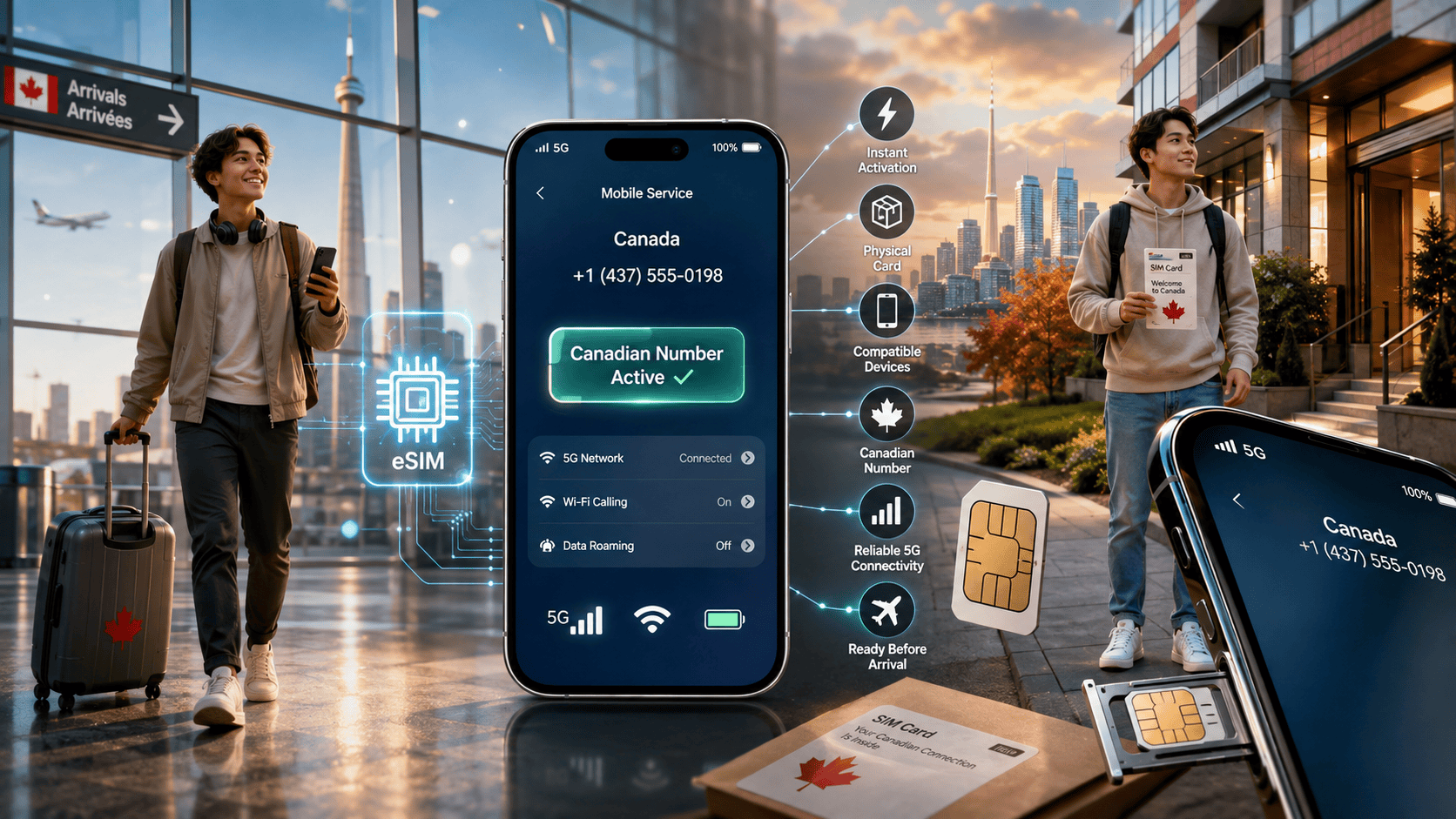
Both get you a Canadian number. The right choice depends on your phone and how you like to travel.
Choose eSIM if
- Your phone supports eSIM (most phones from the last few years do).
- You want to activate the moment you land, with nothing to collect.
Choose a physical SIM if
- You have an older phone, or want a spare you can move between devices.
- You'd rather have a card posted to your Canadian address before you arrive.
Either way, Get Canada Sim sets up your Canadian phone number before you fly. Compare plans and order.
Related:
eSIM vs physical SIM at a glance
If you're still unsure, this comparison covers the differences that matter most when moving to Canada.
| eSIM | Physical SIM | |
|---|---|---|
| What it is | A digital SIM built into a compatible phone | A removable plastic SIM card |
| Installation | Usually added through your phone settings, QR code, or carrier setup | Inserted into the phone's SIM tray |
| Phone compatibility | Only works on eSIM-compatible devices | Works on phones with the required physical SIM slot |
| Moving between phones | May require an eSIM transfer or new activation process | Usually easier to physically move between compatible phones |
| Risk of losing the SIM | No removable card to lose | Small card can be lost or damaged |
| Useful for Dual SIM | Often very convenient | Can also be used with Dual SIM depending on the phone |
| Best for | Compatible newer phones and digital setup | Older phones or people who prefer a removable SIM |
Neither format automatically gives you better coverage, faster data, or a better phone number. Those depend on the mobile plan and network, not whether the SIM is digital or physical.
The most important question: does your phone support eSIM?
This should be the first thing you check.
An eSIM is only useful if your exact phone model supports it. Two phones that look almost identical can sometimes have different eSIM capabilities depending on the model number or country where they were originally sold.
If you're unsure, use the guide on how to know if your phone supports eSIM.
You can also check the broader eSIM-compatible devices list for supported iPhone, Samsung Galaxy, Google Pixel, Xiaomi and other models.
A few things to check before choosing eSIM:
- Is there an Add eSIM option in your phone's SIM settings?
- Does your phone show an EID?
- Is the phone unlocked?
- Does your exact regional model support eSIM?
- Does the Canadian provider support eSIM for your device?
If the answer is no, a physical SIM is usually the simpler choice.
Which is easier to set up after arriving in Canada?
For a compatible phone, eSIM is usually the more digital option because there is no physical card to insert.
You install the mobile profile on the phone and then follow the provider's activation process. If you're unfamiliar with this, see the step-by-step guide on how to activate a Canadian eSIM.
A physical SIM is also simple, but it requires the card itself. Once you have it, you insert it into the phone's SIM tray and complete any required activation steps.
So the practical difference is:
eSIM: digital setup Physical SIM: physical card setup
Neither is inherently difficult. The better choice depends on which process you are more comfortable with.
Which is better if you want to keep your home-country number?
This is where eSIM can be particularly useful.
Many modern phones support Dual SIM, which means you can keep your existing home-country line and add a Canadian line on the same phone.
For example, you might keep:
Home SIM: for existing WhatsApp, contacts, or important messages Canadian eSIM: for your Canadian number and local mobile service
Or the setup could be reversed depending on your phone.
If this is important to you, read the guide on using Dual SIM with your home number and Canadian number.
Before relying on Dual SIM, check exactly which SIM combinations your phone supports. Some phones support physical SIM + eSIM, while others support multiple eSIM profiles.
Which one is easier to move to another phone?
A physical SIM often has the simplest advantage here: you can remove the card and place it into another compatible unlocked phone.
With an eSIM, moving your number to another device may involve:
- an eSIM transfer feature,
- a new QR code,
- your carrier's app,
- or help from the provider.
The exact process varies.
That does not make eSIM difficult, but if you frequently switch phones, repair devices, or keep a backup handset, a physical SIM may feel more flexible.
Choose physical SIM if:
- You regularly change phones.
- You keep a backup handset.
- You want the ability to move the SIM manually.
- You prefer not to depend on an eSIM transfer process.
Choose eSIM if:
- You normally keep the same phone.
- You prefer digital setup.
- Your device supports easy eSIM transfer.
- You want to avoid handling a small SIM card.
What happens if your phone is lost or damaged?
With an eSIM, the mobile profile is stored digitally inside the phone. Someone cannot simply remove your SIM card from the device.
With a physical SIM, the card itself can be removed and moved into another compatible phone.
However, losing either type of SIM service still means you should contact your provider quickly to protect the account and arrange replacement or transfer.
If you rely heavily on your phone after arriving in Canada, it is also worth keeping important account-recovery information somewhere other than the phone itself.
Does eSIM give you better coverage than a physical SIM?
No.
If an eSIM and physical SIM are using the same carrier, same network and same plan, the SIM format itself should not determine coverage.
Coverage depends much more on:
- the carrier network,
- where you are in Canada,
- the frequencies supported by your phone,
- congestion,
- buildings and terrain,
- and the specific plan or network access.
So do not choose eSIM because you expect stronger signal, or physical SIM because you expect better coverage.
Choose based on compatibility and convenience.
Does eSIM use more battery or data?
The SIM format itself is not usually the main factor determining battery or data use.
Your battery life is affected more by things like:
- weak mobile signal,
- 5G usage,
- screen brightness,
- background apps,
- hotspot use,
- and whether you keep two active mobile lines.
Similarly, your data allowance depends on the plan you choose rather than whether it is stored on an eSIM or physical SIM.
Is eSIM or physical SIM better for international travel?
For frequent travellers, eSIM can be convenient because you may be able to add another mobile profile without removing your existing SIM.
That can make it easier to maintain one line while adding another for travel.
However, physical SIM still has an advantage in destinations where local providers do not support eSIM or where buying a local physical card is easier.
So frequent travellers should not look only for “eSIM support.” A more useful phone setup is one that gives you both options.
For example:
Physical home SIM + Canadian eSIM
or
Canadian physical SIM + travel eSIM
That gives you more flexibility than being limited to only one SIM format.
What if your phone supports both?
If your phone supports both eSIM and physical SIM, there is no need to choose based on technology alone.
Ask yourself these questions instead:
1. Do I want the easiest digital setup?
Choose eSIM.
2. Do I regularly move my number between phones?
Choose physical SIM.
3. Do I want to keep my existing SIM in the phone?
An eSIM for the Canadian line may be more convenient.
4. Does my phone not support eSIM?
Choose physical SIM.
5. Am I nervous about setting up an eSIM?
A physical SIM may feel more familiar.
6. Do I travel frequently?
A phone that supports both physical SIM and eSIM gives you the most flexibility.
eSIM may be better for you if...
Choose eSIM if most of these statements sound like you:
- I have a newer eSIM-compatible phone.
- I want to avoid changing physical cards.
- I want to keep my existing SIM installed.
- I prefer digital setup.
- I use Dual SIM.
- I travel regularly.
- I don't often switch between phones.
If that sounds like you, see the current eSIM Canada options.
A physical SIM may be better for you if...
Choose a physical SIM if most of these sound like you:
- My phone does not support eSIM.
- I regularly move my SIM between devices.
- I use an older phone.
- I keep a backup phone.
- I prefer inserting a card over digital activation.
- I want a physical SIM that I can remove myself.
There is nothing outdated about choosing a physical SIM if it fits the way you use your phone.
What should newcomers to Canada choose?
For many newcomers, the choice can be reduced to one simple rule:
If your phone supports eSIM and you prefer digital setup, choose eSIM. If it doesn't, or you want a SIM you can easily move between phones, choose physical SIM.
There is no universally “better” SIM format.
Someone arriving with a recent iPhone and wanting to keep their home SIM may find eSIM much more convenient.
Someone arriving with an older Android phone or who frequently changes devices may be better served by a physical SIM.
The right question isn't:
“Which SIM is better?”
It's:
“Which SIM works better with my phone and the way I use it?”
If you're preparing for a longer move rather than a short visit, the Canada SIM guide for newcomers covers the broader decisions around getting connected after arrival.
FAQ
Is eSIM better than a physical SIM in Canada?
Not automatically. Both can provide normal Canadian mobile service. eSIM is convenient for compatible phones and Dual SIM use, while a physical SIM can be easier to move between devices.
Can I get a Canadian phone number with an eSIM?
It depends on the eSIM plan. Some travel eSIMs are data-only, while others include a Canadian number. If having a number matters, check the plan before ordering.
Can I use eSIM and physical SIM together?
Many modern phones allow this through Dual SIM, but the exact combinations depend on the phone model.
Can I convert my physical SIM to eSIM?
Some carriers and devices support SIM conversion or transfer, but availability depends on the provider and phone. Check your carrier's process before deleting or removing your existing SIM.
Can I switch back from eSIM to physical SIM?
Usually this requires the provider to issue or activate a physical SIM for your line. It is not simply a setting you switch on and off.
Does eSIM work without internet?
You generally need connectivity during parts of installation or activation, but once the eSIM is properly activated, it functions as your mobile SIM. Exact activation requirements depend on the provider.
Is an eSIM permanent?
No. eSIM profiles can usually be removed from the phone, although deleting a profile does not necessarily cancel the mobile plan itself.
What if I delete my eSIM by mistake?
Do not assume the original QR code can always be scanned again. Contact your provider for the correct replacement or reinstallation process.
The simplest decision
If you still cannot decide:
Choose eSIM if your phone supports it and you want a digital, travel-friendly setup.
Choose a physical SIM if your phone does not support eSIM or you value being able to move the card easily between devices.
And if your phone supports both, you are not locked into one approach forever.
Before choosing, check your phone compatibility, understand the activation process, and then compare Canada SIM plans based on the actual service you need.
Follow Get Canada Sim on Google
Make Get Canada Sim a preferred source to find our latest Canada SIM and eSIM guides in Google Search.